

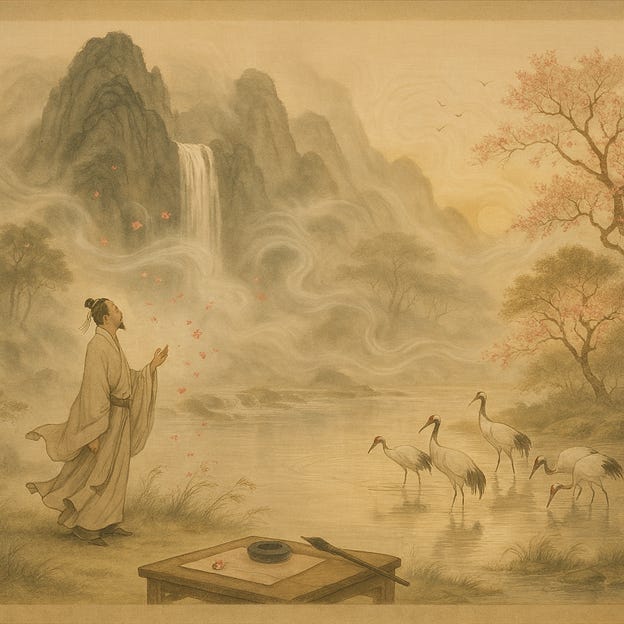
Chinese Poetry
A Comparative Analysis of Chinese and Western Poetry
Chinese poetry and Western poetry have distinct literary traditions, yet they share fundamental themes of human experience, nature, and morality. Chinese poetry, particularly during the Tang Dynasty, is characterized by regulated verse (lüshi), parallelism, and tonal harmony.[1] Stephen Owen’s The Great Age of Chinese Poetry explains in depth the precision of Tang poetry, noting that its structure relied on balanced couplets and intricate rhyme schemes.[2] In contrast, Western poetry, in its classical and medieval forms, utilized metrical patterns such as iambic pentameter in English poetry or dactylic hexameter in Greek and Latin epic poetry.
While both traditions explore themes of love, war, nature, and political turmoil, Chinese poetry tends to be more concise and imagistic, focusing on concision and suggestion rather than explicit narrative. William Hung, in Tu Fu: China’s Greatest Poet, emphasizes the restraint and emotional depth in Du Fu’s works, where a single quatrain can evoke imagination.[3] “The Chinese poet uses his pen to mark only the heights of his ecstasy and inspiration. The scene may be rich in the story complicated with details. These details the poet will attempt to leave as much as possible to the ingenuity and imagination of his readers. In tofu we meet a poet who delights in telling the most with the least number of words.” [4]
Western poetry, on the other hand, often embraces extended metaphors and elaborate storytelling. Epic tales such as Homer’s Iliad and Dante’s Divine Comedy are examples of moral storytelling through a fantastical lens. Shakespeare as well can be added to the list of timeless western literary greats, however his works were more for enjoyment, even if they carried a moral message, they did not evoke actual societal change.
The role of Confucianism in Chinese poetry added moral dimension that prioritized social responsibility and ethical governance for scholars and officials. Making poetry a means of communicating for governance.[5] “In the early 7th century, poetry was primarily a stylized form of social discourse practiced mainly in court circles. “By the end of the 8th century, poetry, while retaining its function as social discourse, had also become a conscious art form serving a variety of ends and practiced by a wide range of literate Chinese. Never in traditional China was poetry and autotelic “pure art” in the western sense: it was bound both to occasion and to concepts of poetry as the expression of inner nature or as a vehicle for the enduring principles of the civilization.”[6] This ideology differs from the Western tradition, which, while influenced by religious and philosophical frameworks such as
Christianity or Romantic individualism usually pursued personal expression and existential questioning. Chinese poetry as well requires the reader to understand the situational nuance, timing, and background to have accurate interpretations, unlike Western poetry which is more literal and expansive. “The less accurately we know the time, the place, and the circumstances in the background, the more liable we are to imagine it incorrectly and the result will be that we either misunderstand the poem or fail to understand it altogether.”[7] Despite these differences, both traditions have shaped global literature, influencing generations of poets and thinkers across cultures.
[1] Stephen Owen, The Great Age of Chinese Poetry: The High Tang New Haven, CT: Yale University Press, 1981, p 14.
[2] Ibid., Owen p 3.
[3] William Hung, Tu Fu: China’s Greatest Poet, Cambridge, MA: Harvard University Press, 1952, p 5.
[4] Ibid., Hung, p 5.
[5] Stephen Owen, The Great Age of Chinese Poetry: The High Tang New Haven, CT: Yale University Press, 1981, p 22
[6] Ibid., Owen, p 3
[7] William Hung, Tu Fu: China’s Greatest Poet, Cambridge, MA: Harvard University Press, 1952, p 5.
Dorie, I love how you made this feel like walking between two gardens — one all mist and moonlight, the other full of long winding stories. Your breakdown was such an easy, enjoyable read, and I found myself smiling at how neatly you tied everything together. Truly, this piece made my morning a little brighter~
Thank you for the piece. I had forgotten about Chinese poetry for a while, even though I have the Shijing (The Book of Songs) in my bookcase. I should dust it off and read it again!