

I was first introduced to Rafa Joseph by AsukaHotaru. I was intrigued by his poetry and offered to write a piece with him. To say I was thrilled and surprised with the piece he offered is an understatement. I could not wait to get started on this post, especially because it speaks to a theme that is dear to my heart. Without further ado, I welcome Rafa Joseph to White Rabbit Musings.
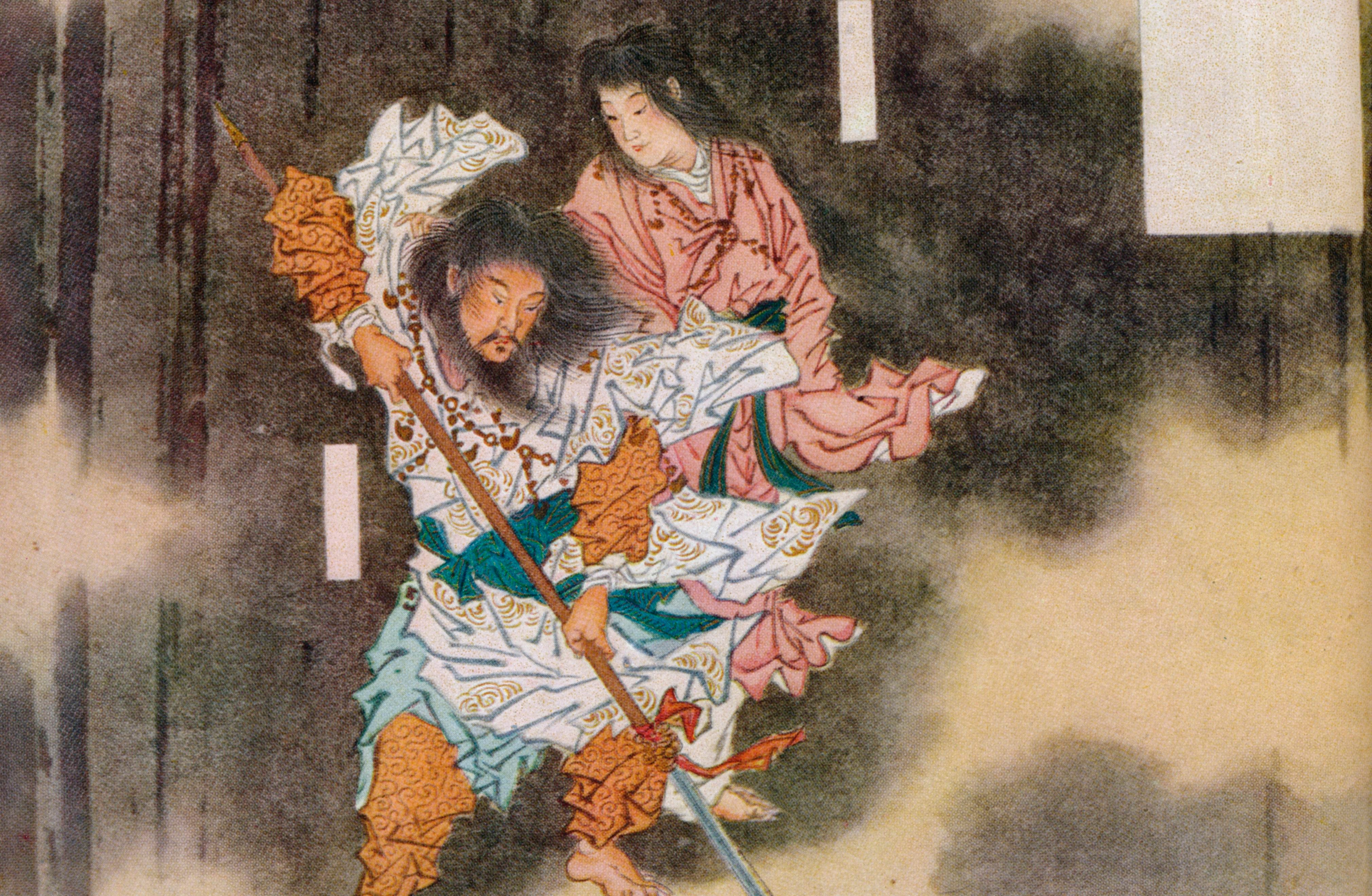
Izanami Stuttered by Rafa Joseph
Izanami stuttered and was shuffled off the stage.
She slept about a fortnight, and she wrote about a page.
The words were out of sequence, but the message was: ‘Desire
combusts when mixed with hopelessness, and revels with the fire.’
The FIRE within her belly came out freezing, and the chill
entombed her will to live... beneath an AVALANCHE of will.
She frenzied in the fields with all her apoplectic joy,
just like a child of No One — with the planet for her toy.
When Izanagi stumbled on his starlight’s open grave,
he censored, with a boulder, all the darkness of that cave.
Then, live or dead beneath it, she was heard no more to cry;
no conduit remained to cast her visage ‘fore the eye.
Self-pity lost its patroness and sanction, ‘neath his laws.
The Heavens gave their signature and THUNDERED with applause!
Of course, he sowed the fields with his apologetic thread —
and everything grew verdant, in that garden overhead.
When Izanami stutters, don’t pretend she is to blame.
Her words could but ILLUMINATE a hecatomb of shame.
Where floors are stained with dust, you take a broom and find a rug:
that all be swept beneath, to seek its resting place above.
The road and SKY are mirrors! ... and to walk between the twain
requires a stoic face, a steady hand, and sturdy frame.
But face cannot be saved for long; it always catches you!
The farmer hoes beneath a mask the scarecrow looks straight through.
Where tainted flesh has struck the EARTH, the curse is in the soil —
and nothing taken by the scythe, and nothing left to spoil —
for who would dowse such fields: for either prophesy, or joy?
I am the child of No One... and my sorrow’s just a toy.

RAFA’S REFLECTION
As a member of the elder cohort of millennial Americans, my chief exposure to Asian culture was through Japanese video games. No one I knew from my small town could tell whether Cambodia was a country or eating disorder, and although anime was known to some of us, it had not yet reached its present crescendo of popularity. Even Pokémon became popular with children, well after I’d ceased to be a child.
Being a longtime JRPG junkie, I began writing this poem after spending well north of a hundred hours playing through Shin Megami Tensei: Persona 4: a school life-simulation game set in rural Japan, about a band of ordinary teens who repel the gradual, foggy encroachment of shadow monsters upon their hometown, by fighting them in their native dimension — accessible only by phasing through the screen of any television.
Trust me... this plot bangs much harder than it seems to have any right to.
Experiencing this genre masterpiece inspired me to investigate the origin of nearly every monster in the game, including several Shinto deities. During my research, I conceived of the poem as an alternate explanation for certain mythological events, instigated by a crude act of impatience toward a vocally inhibited woman (who may or may not be a goddess).
Incorporating ideas from Shintoism and Gnosticism, the piece tells an apocalyptic story: allegorically representing a set of projected ramifications of the sort of mundane ‘silencings’ that are always conducted (by ‘heroes’ of normalcy), merely to spare would-be listeners some anticipated annoyance. As a pathologically awkward soul who nonetheless appreciates the courtesy of being heard, I have cultivated a sincere contempt for such occurrences.
Each of us goes through life sealed inside our own cave of personality. It so happens that some of us exist, whose very natures represent a threat to the continuity of the uncodified religion of all the others. We ‘trueborn pariahs’ fret to discover that our caves have been doubly sealed — once by the champions of culture; again, by the guardian-deities of decorum.
What one views as providential, all to readily becomes a curse for another. Dissent is guarded against and punished, vigilantly as theft.
I pace my sacred prison, awaiting amnesty. I have stolen nothing.
Dorie’s Reflection:
When I first read Rafa’s poem, I thought what in the world is he trying to tell me. My sons love Persona, my youngest especially. Then I read it again. I sat with it for a little while, and I realized it was an epic social condemnation on silencing voices of those who don’t follow the crowd. Those who are not on the socially acceptable path of conformity.
Silencing women.
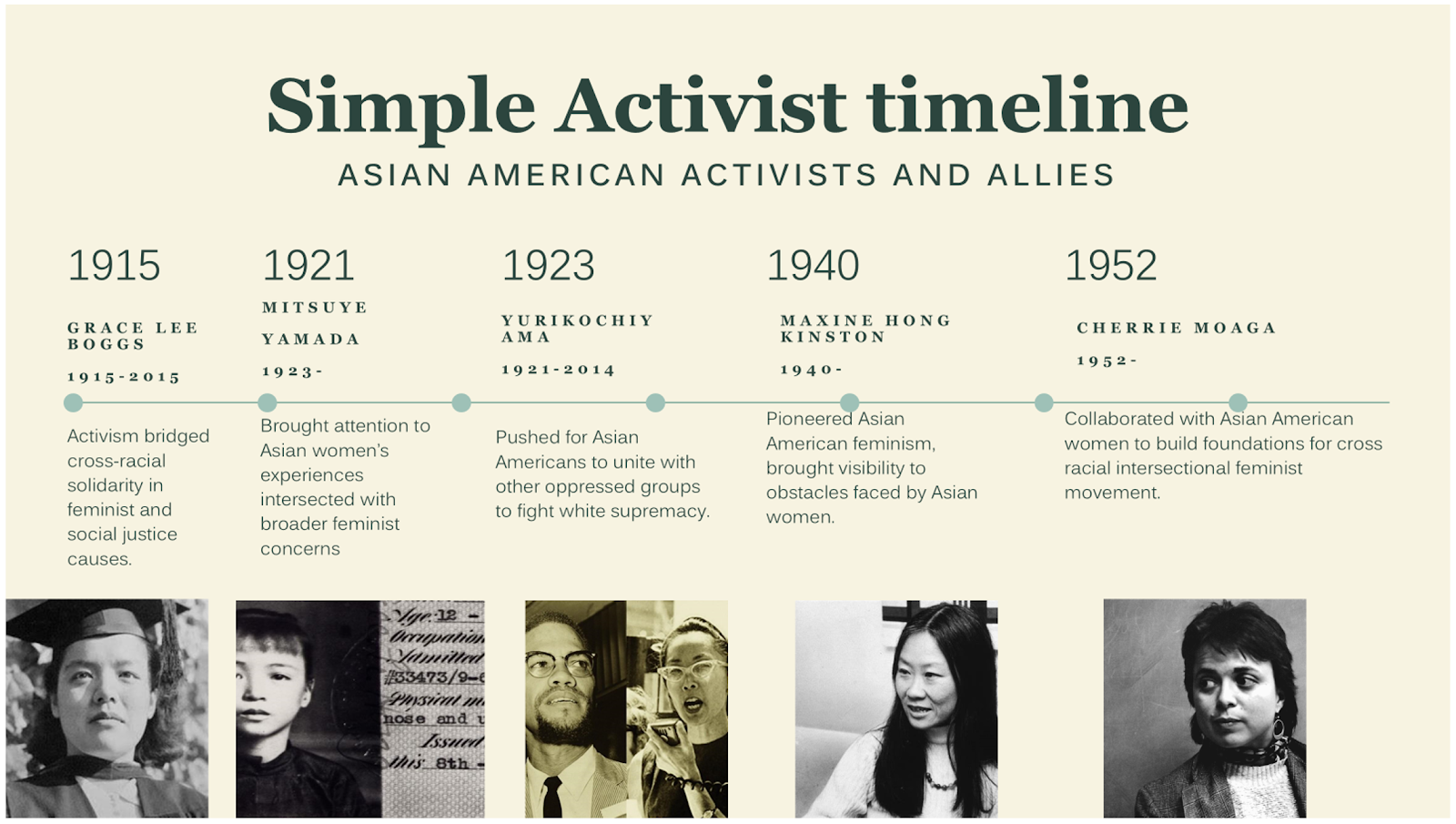
One of my most memorable classes in undergraduate was a study on Asian American women activism. There is a long and glorious history of female activism for equality in the Asian American community. I’ve listed a few below.
Rafa’s poem re-imagines the Shinto myth of Izanami and Izanagi. He was inspired by the psychological landscapes of Japanese role-playing games. He then utilized them to create a social discourse that condemns silencing the voices of those who do not comply.
I myself do not play these games, but my children do. I had a long talk with my oldest son who is quite a fan. We discussed the psychological and social impact that these games have on young people and social discourse.
It occurred to me, that this is an ongoing social disparity that has not been solved by any means. Historically, those who do not comply, were silenced, ruined, evicted, and expelled. He made a good point saying that these games require you to kill the deity, which makes you realize you have the power to overthrow systems of oppression.
Rafa explores the consequences of silencing the different or disruptive voices in his epic lament. He uses a theme that resonates with anyone who feels like they are a stranger in this world built by oppressive hands. He urges us to overthrow the system of oppression.

An Ode for the Unheard
They tell me to sit. To be sweet.
To be nice.
My hands raw, bleeding and scabbed,
beating a ceiling that will not become a door.
The past is not behind me it is in the air,
thick, slimy, tasting of salt.
They promised a larger world.
We held the line until our backs were bent.
Too many of us resigned into silence,
a retreat into ease and cowardliness.
They measure my worth between my legs
a factory forced to reproduce
the next generation of compliant
A warm, wet production line.
My rage is not a metaphor.
It is a second heart.
Be still, they whisper. Be quiet.
Shhhhhhhhhhhhhhhhhh
As if my silence could make
their words profound, not the dry rustle
of bodies littering the ground.
This war, not new, for centuries we’ve fought
In desperation equality we’ve sought.
with the weapons we were allowed:
needles, words, withheld smiles,
We Watched them burn it down.
Now we watch the world they built
on our silence burn to embittered ash.
They call us weak, even as they choke
on the smoke of their own dominion.
They would have no throne, no crown,
were it not built upon our kneeled backs.
Our broken bodies, souls ripped apart
No kingdom, without our quiet hands
to hold its crumbling walls…to hold its heart.
We did not start this carnage,
We will determine the finish of this fight.
The hands that press us down
will fall to become the ground
beneath our rising might.
This poem of mine is dedicated to all women who have risen up to overthrow the bonds of patriarchy. the strong, independent, women who will not go quietly and will not be silenced.
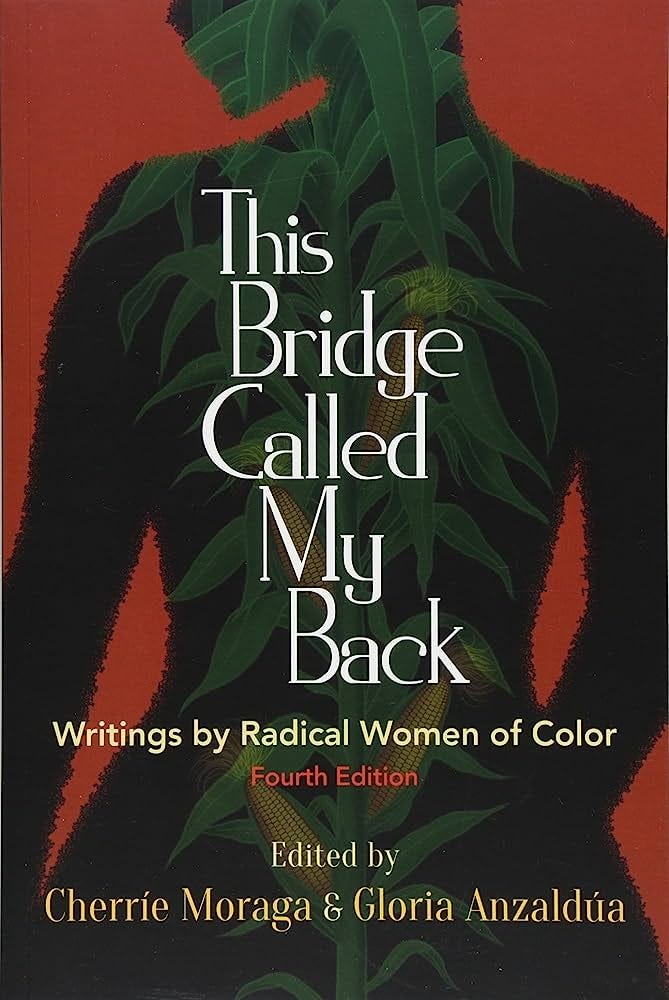
If you are interested in learning more about feminist activism in communities of color, I humbly suggest this book. It is one of the best I have ever read. This Bridge Called My Back: Writings by Radical Women of Color is a feminist anthology edited by Cherríe Moraga and Gloria E. Anzaldúa.
It was my great pleasure to work on this with Rafa Joseph . please take a few minutes to visit his page, subscribe, and read his work.
Please let us know if any line or phrase caught your attention. If you have a story to share, please feel free. Let us know in the comments what you think.
Thank you so very much for reading, we appreciate your time. Many Blessings.
Thank you, Dorie, for bringing my poetry to a broader audience — and for decorating it with such splendid photos, and a most worthy cause! The rabbits are beautiful, and your readers most graceful. No better time could be had by any poet.
Seeing how criticism is the highest form of flattery, please allow me to pose a question:
Would it truly be helpful to see the world of things built by men 'burn to embittered ash'? This world contains many useful things: vaccines to stymie disease; running faucets and operational toilets, to manage inflow and outflow; air conditioning (although I'll be first to admit my sex has an annoying habit of setting it uncomfortably low). I humbly hope that this desire to immolate, contains at least *a bit of* hyperbole. Just enough to permit me to keep my writing desk, my piano and a CamelBak for hiking.
In my view, it is a tremendous benefit for persons of each social group and persuasion to have free access to things built by every other. I would hate to be forbidden all cultural appropriation, and condemned to do math problems without Arabic numerals. Maryam Mirzakhani, the first woman to win the prestigious Fields Medal for mathematics, would likely concur.
The achievements of every human demographic fit snugly within the realm of human achievement, and ought to belong to all (wo)mankind. Even inventions created prior to the advent of women's rights were not uniformly built 'upon the kneeled backs' of women, as many females actively participated in their creation, and in the sustenance of the lives of their creators. In many cases, females *were* the creators.
Considering the massive disparities in (formal and informal) rights and liberties enjoyed by women between different cultures and time periods, I do not see how it can be productive to collectivize the female sex into a singular interest group, and advocate for the empowerment of this group by calling for it to metaphorically 'tread upon' a future floor wrought of masculinity. A variety of different women would benefit from this scenario, for sure, but several would also suffer. Those whose status and resources result from their alignment with powerful men, or their positions within male institutions, come to mind.
This isn't a point I can comprehensively argue within the space of a short comment, but I do believe that men and women need each other. Not as discrete gendered factions of humanity with unique roles complementing one another (as in the patriarchal worldview), but as (biologically) distinct arrays of unique individuals with overlapping interests and skill-sets, fated to integrate via consensual cooperation (as in the liberal worldview).
With all due respect to my most graceful and formidable hostess, there is a point beyond which gender activism becomes illiberal. This is the point *beyond which* I would prefer that it not be taken.
I'm working hard on a stage musical set in 19th-century Russia, chronicling the plight of one ambitious woman during the "turn" of 1st-wave feminism. Writing in this time period is incredibly satisfying, as none of the voices for social justice from it were anywhere close to going too far (perhaps save those few aching to expropriate and trample 'the bourgeoisie'). This setting permits me to lend my pen to the cause of social justice and rage away at full fury, without accidentally razing any whole civilizations.
The power of the feminine is alive and well, I feel it in this piece!! So proud of you both and your will to describe in aesthetic lore, the power of the heart and the soft hands really sat with me… and how the words contrast the immense fortitude — paralleled, yet highly variable in many ways — in relation to the power struggles happening on earth, with the nourishing energy enduring through the plight. The piece really does embody the strength to persevere and not be extinguished. WowZ & BowZ in respect to this!