
林间茶/Tea in the Forrest
Poem Dedicated to Abram Newcomer for my 1000th Subscriber.

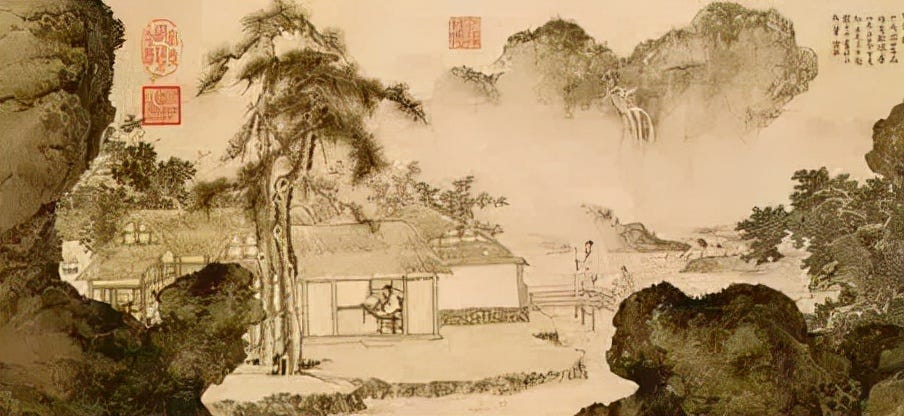
Painting title 事茗圖, Shi Ming Tu, (Making Tea) created by the legendary scholar-artist Tang Yin (唐寅, also known as Tang Bohu) during the Ming Dynasty.
I was so excited when Abram Newcomer my 1000th subscriber asked for a poem in a traditional Chinese style, and to be as close to English translation as possible. With the help of my Mentor 吴老师,we came up with this.
林间茶
竹影斜侵石径凉,
故人携茗就松香。
泉鸣瓦铫春云湿,
风落藤花暮齿香。
世事浮沉皆一笑,
山禽啼笑两相忘。
归时但觉烟霞重,
犹带清芬满客裳。
English Translation
Tea in the Forrest
Bamboo shadows slant on the stony path so cold,
Old friends bring tea where pine fragrances unfold.
Spring clouds dampen the clay pot with spring’s own sound,
Wisteria blooms fall to teacups fragrant round.
Let worldly ups and downs dissolve in a smile,
Birds sing, we laugh, both lost to care awhile.
Going home, we find mist and sunset grow deep,
Yet our robes still hold the scent that tea-drinkers keep.
How this was created.
If anyone has read my academic papers you know I love Du Fu and Confucianism. Both have had incredible influences on my life and my academic journey. The style of this poem follows closely the style and form Du Fu was famous for. Tea in the Forest is written in the regulated verse lǜshī, 律诗 style of classical Chinese poetry jintishi, 近体诗.
Qī yán lǜshī, 七言律诗, is a seven-character regulated verse with eight lines. Each line’s seven characters follow a strict tonal pattern and rhyme. Mandarin is a tonal language, which means that the pitch and tone variations distinguish what the word means. When creating traditional Chinese poetry it is imperative you match tones.
The rhyme scheme uses the same rhyme throughout. In this poem, the “-ang” sound in lines 1, 2, 4, 6, and 8. The middle two couplets’ lines 3–4 and 5–6, follow the required parallel structure duì’ǒu, 对偶.
Video on How to Read Chinese Poetry Shakespeare Verses Du Fu
Let’s Break it Down
The first part is matching. Well, honestly, it’s not just matching characters and tones it’s a little more than that. Du Fu is famous for strict, meaningful parallelism in his middle couplets. Meaningful Parallelism does not mean only characters and tones; it also means matching philosophies, historical events, natural disasters in some cases, and thoughts. (Caveat, it is important to note that Daoism and Confucianism are theoretical philosophies, not religions.)
The middle two couplets have the required parallel structure. If you read many of Du Fu’s poems, he was famous for this technique. I dare say no one before or after did it as well as he did.
In the second couplet, “Spring clouds dampen the clay pot with spring’s own sound, / Wisteria blooms fall to teacups fragrant round.” Notice how “spring” balances with “dusk,” “wet” contrasts with “fragrant” in touch versus smell. The sound of spring water “pairs” with the movement of wind-blown flowers. The third couplet continues mirroring.
“Let worldly ups and downs dissolve in a smile, / Birds sing, we laugh, both lost to care awhile.” Human affairs versus mountain birds, abstract rise and fall against concrete singing and laughing. These become the rhythm and meanings reflect each other very well. Mirror contrasts.
Du Fu rarely declares emotion directly. Maybe only once or twice can I think of a poem where he says his true feelings outright. Using that, instead of saying “I am happy,” I try to show all the happiness and emotion in one smile, understated, almost dismissive. “Both lost” suggests not forgetting worries but dissolving of self and nature. The closing line, “Yet our robes still hold the scent”, lets the memory of joy linger “physically” rather than stating it emotionally.
Nature serves as a moral mirror. The slanting bamboo shadows suggest seclusion and integrity. Pine fragrance evokes constancy, both traditional Chinese symbols. Wisteria blooms offer beauty touched with gentle melancholy, because the blooms are so fleeting. And the mist and sunset glow in the final couplet, are nods to the classic Daoist-tinged associations with transcendence.
This poem elevates an ordinary moment, tea with friends in a humble forest setting.
Then helps to transition it into a universal reflection. When creating a traditional poem of this kind it is in ordinary moments where you find the most joy, most understanding, most love… in elevating things that are often taken for granted. The clay kettle is simple and rustic, the stone path deliberately cold and modest. There is no grand pavilion here. From the external scene in the first four lines, to internal reflection in the next two, and finally to a lingering “aftertaste” in the closing couplet. Observation turned into insight, then into enduring impression.
Hopefully, Du Fu is not angry with my simple attempts.
White Rabbit Musings is my labor of love. This publication is reader supported. All articles will remain free domain, however if you would like to support my work, please consider becoming a paid subscriber or buying me a book. Thank you so very much for reading. I appreciate your time.
This was a beautiful poem
Probably even better in Chinese
Might have to learn a new language
lol
Even just the length of each line, the busyness of the characters, the "size" of the script...
it goes to show how much of translation is interpretation.