
Tens
Part IV. Final Episode


VII. Palm Beach
(December 1931)
The Breakers is the same.
That is the cruelty of hotels.
They do not remember.
The same gold leaf.
The same crystal.
The same painted clouds
that never rain.
He came back because he
had nowhere else to go.
Because the migration is a river
and he is a leaf.
Because The Midnight still sways
and he still sleeps alone
and he thought
fool, fool, fool!
He thought that
she might be here too.
She is.
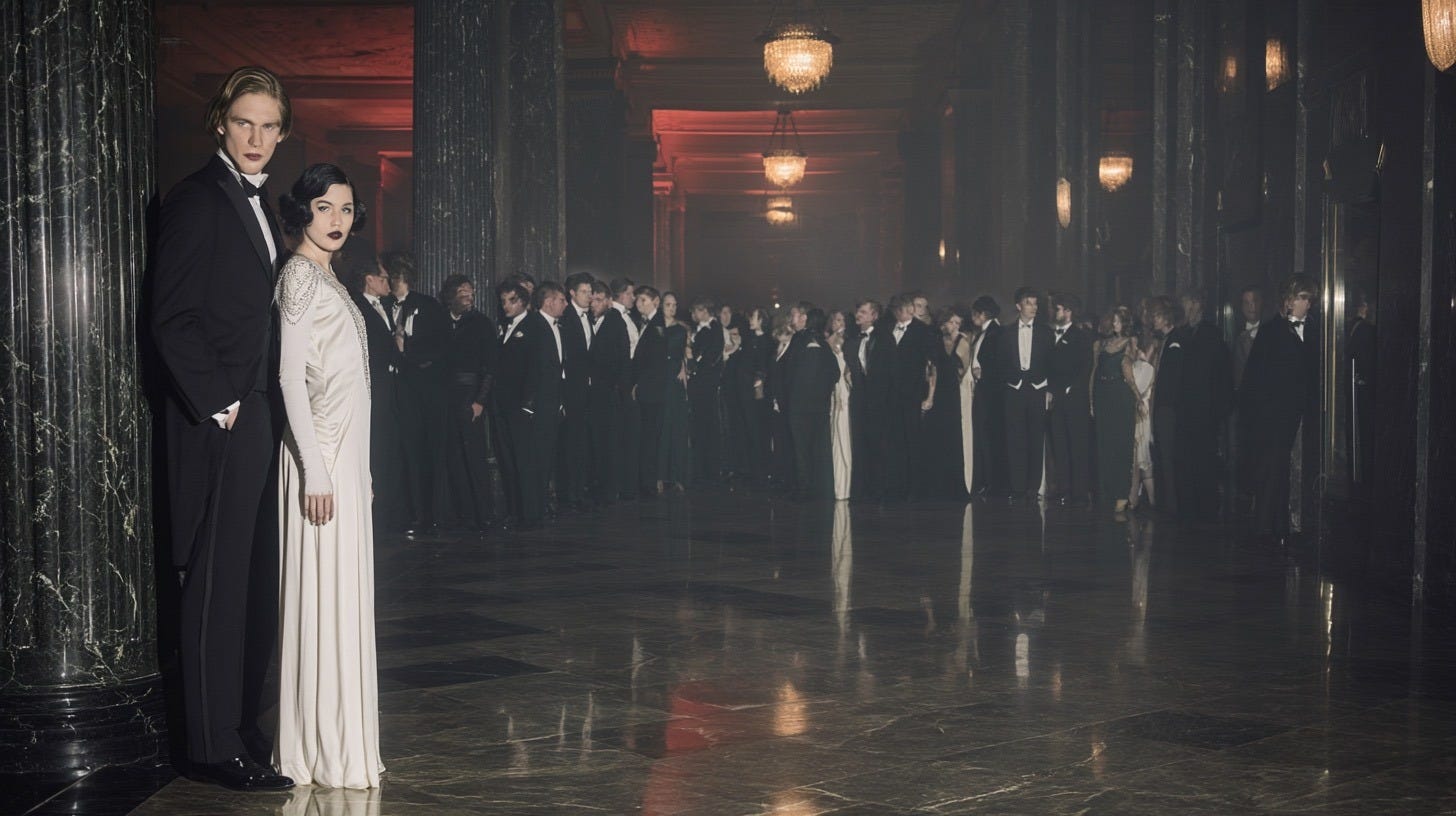
He sees her across the ballroom.
Same style silver dress.
Same black hair.
Same impossible smallness.
But she is not alone.
A man stands beside her.
Tall. Blond. Safe.
His hand on her waist
her waist, that waist,
the one his hands remember
like he owns it.
Like he has always owned it.
William stops.
The orchestra plays something fast.
Someone laughs.
Ice clinks.
He should walk away.
He knows he should walk away.
His feet do not listen.
“Tens.”
She turns.
Those brown eyes.
Bourbon. Crystal.
The bottom of a glass
he drained and broke.
Left on a balcony
in Montauk.
“Hortense now,” she says.
“Mrs. Arthur F. Covington III.”
Her voice is flat.
Polite.
The voice you use for a stranger
you met once
at a train station
a lifetime ago.
The blond man extends a hand.
“Arthur,” he says.
“Friend of my wife’s?”
William shakes it.
His own hand feels like someone else’s.
“No,” he says. “Just passing through.”
“William and I knew each other,” Tens says.
“Briefly.”
“Last season.”
“Briefly.”
The word hangs.
Briefly.
Like a knife.
Like a door closing.
Arthur smiles.
Arthur is a good man.
William can tell.
Arthur probably opens doors.
Arthur probably sends flowers.
Arthur probably says I love you
without choking on the words.
Arthur probably knows
what he wants
and wants only that,
and sleeps like a baby
every single night.
William hates him.
Instantly. Completely.
Forever.
But he is polite.
He was raised polite.
Money does that too.
Teaches you to smile
while bleeding internally.
“Congratulations,” he says.
“Thank you,” Arthur says.
“Small wedding,” Tens says.
“Just family.”
“Very small.”
She looks at William.
Just for a second.
Long enough.
Short enough.
You were not there, her eyes say.
You chose not to be there.
You were conflicted.
Arthur drifts away.
Someone needs him.
Someone always needs
a man like Arthur.
A man who shows up.
A man who stays.
William and Tens stand alone
in a room full of people.
The distance between them
is the length of a year.
The length of a silence.
The length of I can’t tell you.
“Congratulations,” he says again.
“You said that.”
“I mean it.”
“Do you?”
“Englishman, hum?”
She turns to leave.
Silver beads.
Black hair.
That impossible small back.
“Tens,” he says.
She stops.
She does not turn around.
“Why?” he says.
The word is small.
Small as her.
Small as he feels.
Small as everything he lost
because he could not say
what she needed to hear.
She turns.
Slow.
Her brown eyes are dry.
She practiced this.
He can tell she practiced this.
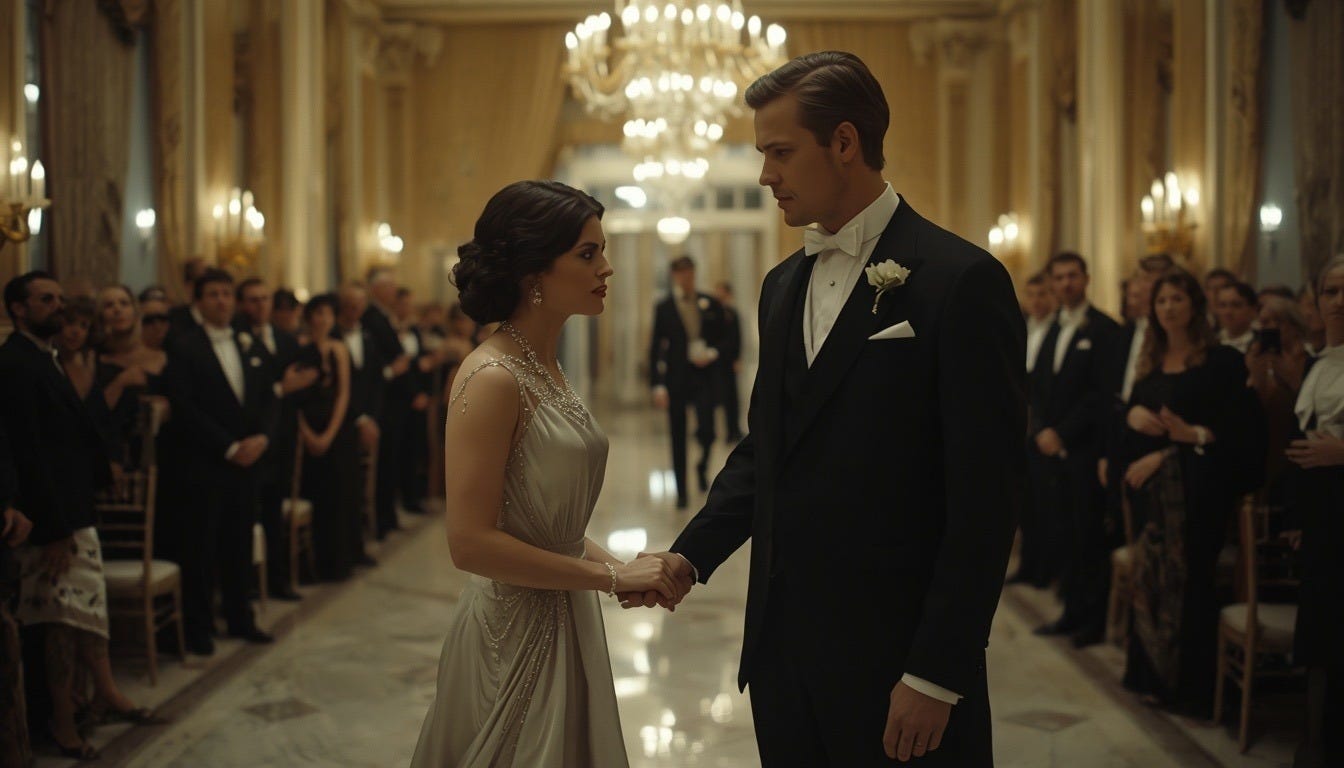
“Because,” she says,
“He wasn’t conflicted.”
The orchestra plays on.
The ice melts.
The painted clouds
stay painted.
William stands alone
in a room full of people.
He feels every mile
of every track
he should have followed
but didn’t.
The Midnight waits outside.
It is always waiting.
It will always be waiting.
He walks toward the door.
He does not look back.
He is too polite for that.
And too much of a coward.
But somewhere
in the sway of the car,
in the dark of the berth,
in the space between
dreaming and waking.
He will hear her voice
for the rest of his life.
He wasn’t conflicted.
And she will be right.
And he will be alone.
And the migration will continue
without her.
Always without her.
VIII. The Midnight
(1935 — 1952)
The car sways.
It always sways.
Mahogany and brass and the low
growl of steel on steel.
He is fifty now.
Or close enough.
The mirror in the berth
shows him a man
he does not recognize.
Gray at the temples.
Lines around the eyes.
The same hands.
The same empty hands.
He still pours two fingers of Scotch.
Still drinks it in one.
Still pours another.
She is not here.
She will never be here.
He knows this.
He has known this
for five years.
For six.
For however long it has been
since Palm Beach
since Arthur
since he wasn’t conflicted.
The migration is a habit now.
Not a choice.
Fall in New York.
Winter in Palm Beach.
Spring in Atlantic City.
Summer in the Adirondacks.
Montauk Manor in August.
He is a glutton for punishment
the balcony still smells
like gardenias.
If he closes his eyes,
holds his breath,
pretends…
He sees her everywhere.
A black-haired woman
reaching for a paper.
A small woman in silver
crossing a ballroom.
A laugh that sounds
almost like hers
but isn’t
but almost
but never.
He follows them sometimes.
Not far.
Just long enough to see
their faces.
Their brown eyes.
Their not her eyes.
He always walks away.
Always.
Because none of them are her.
And he has become
that most pathetic of creatures.
A man who had everything
and lost it,
knows it,
cannot stop knowing it.
He heard about her
through the grapevine.
Society news.
Things the porters whisper.
The things old women trade
like cards at bridge.
Mrs. Arthur F. Covington the Third.
Three children now.
Two girls, a boy.
Stopped traveling.
Lives in that big house,
London.
Very quiet.
Very proper.
Very happy.
Happy.
The word sits in his chest
like a stone.
He wants her to be happy.
He does.
He wants her to have everything
he could not give her.
But God!
God, he wishes it
did not hurt so much
that she found it
with someone else.
He never married.
People asked why.
He told them he liked being alone.
He told them he was married to the road.
He told them lies
so smooth
so polished
that even he believed them.
…some nights.
The Midnight knows.
The Midnight remembers.
The sway of the car.
The dark of the berth.
The dream that was not a dream
and the woman who was
the confession he could not make
the silence that followed.
He still dreams about her.
Not every night.
Just the nights that matter.
The nights when the moon is quiet
the track is straight
the whiskey is just strong enough
to blur the edges.
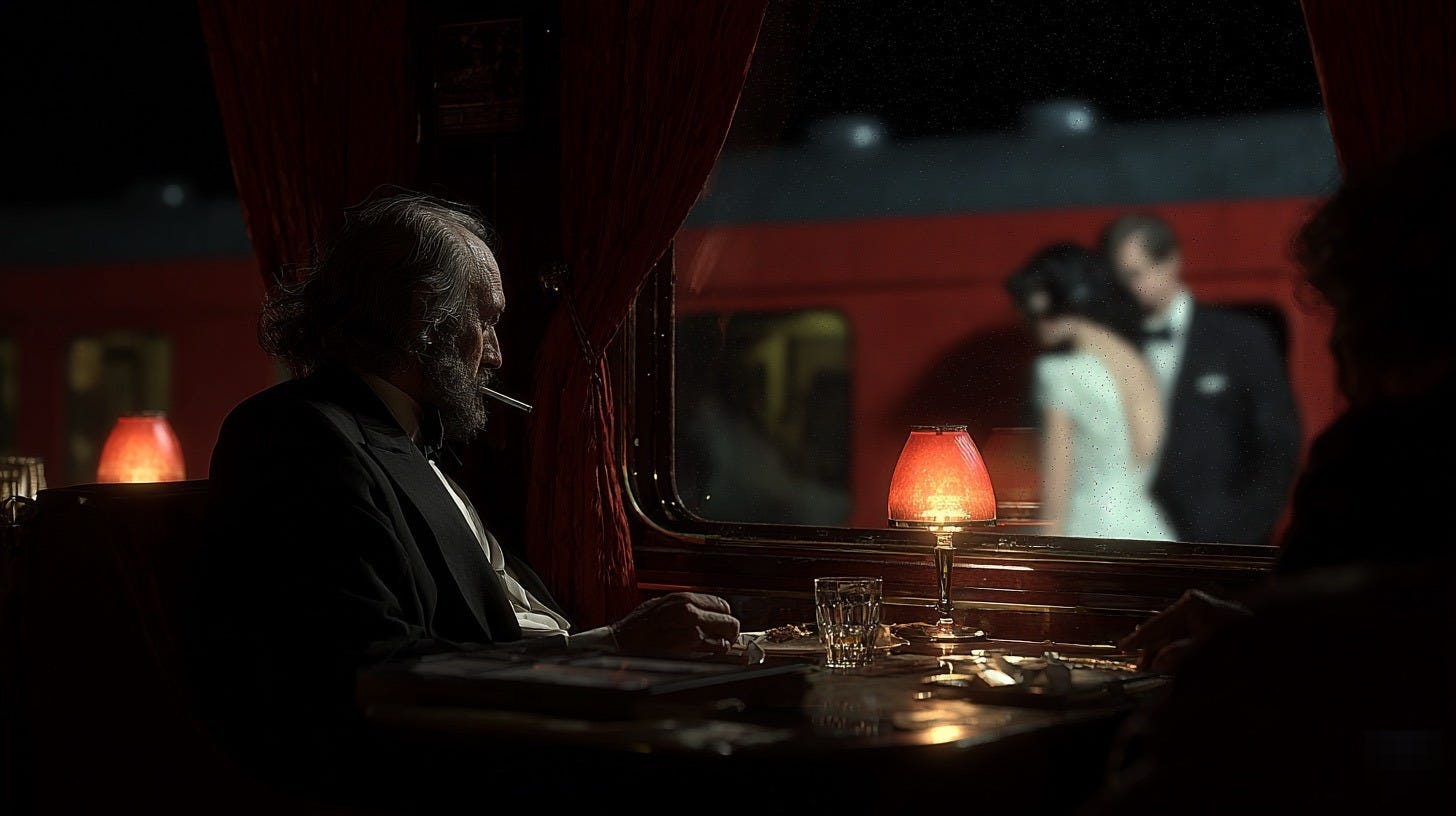
In the dream, she is young.
In the dream, he is young.
In the dream, he says:
“I choose you. Only you. Always you.”
And then he wakes up.
And the car sways.
And the berth is empty.
And she is in London
with her children
with her husband
with her quiet, happy,
proper life.
And he is here.
Still here.
Still moving.
Still searching for something
he threw away
on a balcony
in Montauk.
Because he was afraid
of his own shadow.
The train slows.
A station.
Somewhere.
He does not look up.
A woman boards.
Petite. Dark hair.
His heart stops.
She passes.
She is not her.
She never is.
But for one second
one glorious, painful,
stupid second
she was.
And that is why he still rides.
That is why he still searches.
That is why he will die
on this train
with her name
on his lips.
“Tens.” a small groan.
He pours another Scotch.
The ice has melted.
He drinks it anyway.
The Midnight pulls out of the station.
The night is black.
The track is long.
And somewhere in London,
a woman with bourbon eyes
tucks her grandchildren into bed
and does not think of him at all.
Or so he tells himself.
Because the alternative
that she thinks of him sometimes,
that she remembers the terrace,
that she wonders what
would have happened
if he had been less afraid.
The alternative would kill him.
And he is not dead yet.
Not quite.
Not while the train still runs.
Not while there is still
one more stop
one more woman
one more chance
to see her ghost
in someone else’s face.
The car sways.
It always sways.
William closes his eyes.
And dreams of what he lost.
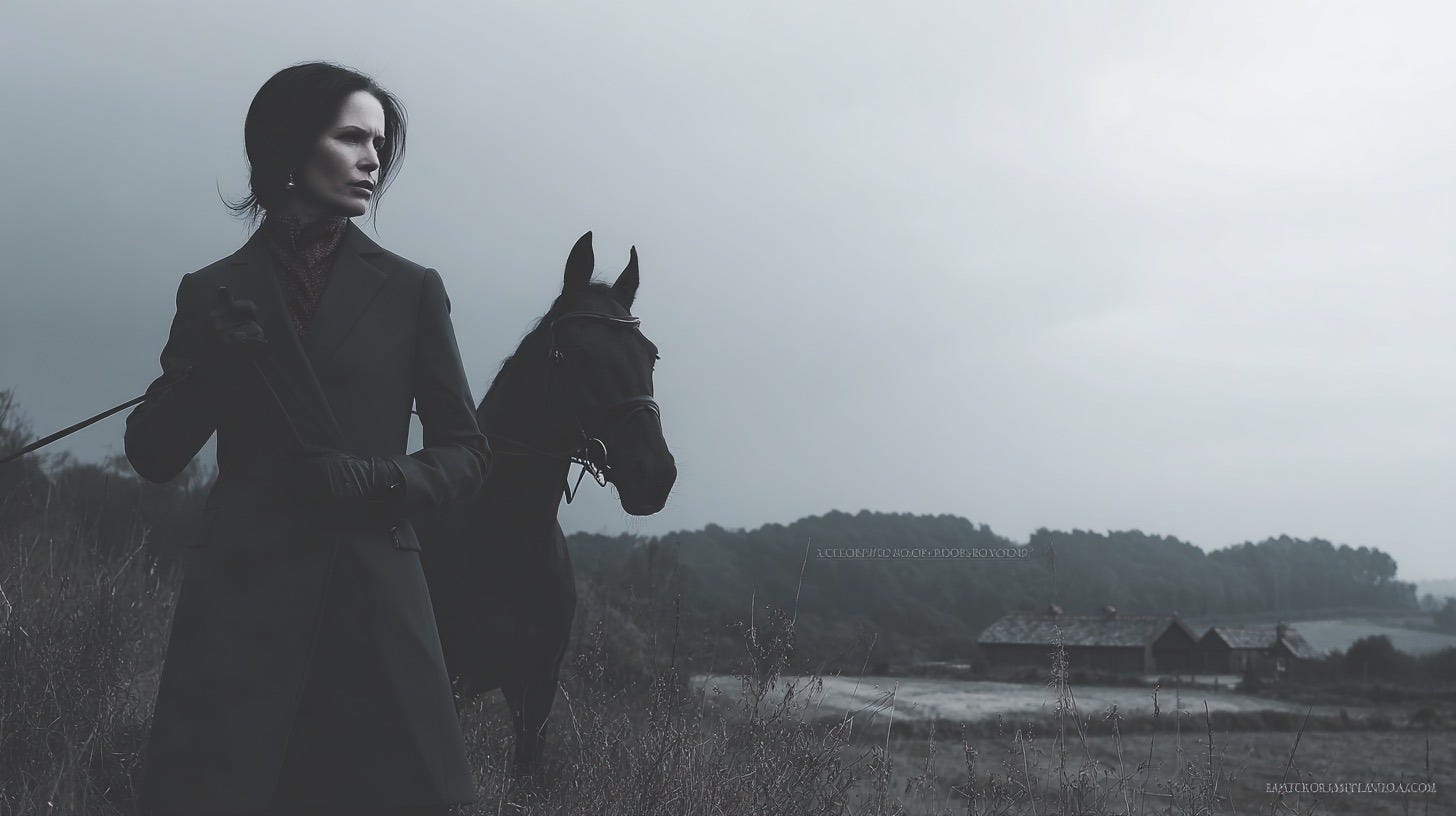
~The End~
A final post on Tens will be available soon. You will get to see behind the scenes fully. What inspired this story, how it was researched, what pop culture and historical references were used. I would like to thank my partner in crime and poetry cohort Mark Crutchfield , for all of his support and help with Tens. He jokingly says he is “Just the cameraman.” But he made this possible. I would never have let this see the light of day without his support and confidence in my ability to go beyond Ancient China. This story meant a great deal to me. I felt like Tens and I had a deep connection. While I am happy Tens found a good ending, a safe ending, I will still miss talking to her every day and asking her, “What today Tens?” and in my heart hearing her say, “Whatever the day brings Ms. Snow, whatever the day brings.”
White Rabbit Musings is my labor of love. This publication is reader supported. All articles will remain free domain, however if you would like to support my work, please consider becoming a paid subscriber or buying me a book. Thank you so very much for reading. I appreciate your time.
You have no idea how much of a fan I am of this ending.
I love bittersweet endings. The nostalgia, the longing.
This was beyond beautiful.
I cry.
I love it.
That really was incredible and very well done. An ending that is fitting too.
The whole thing was wonderfully crafted.