

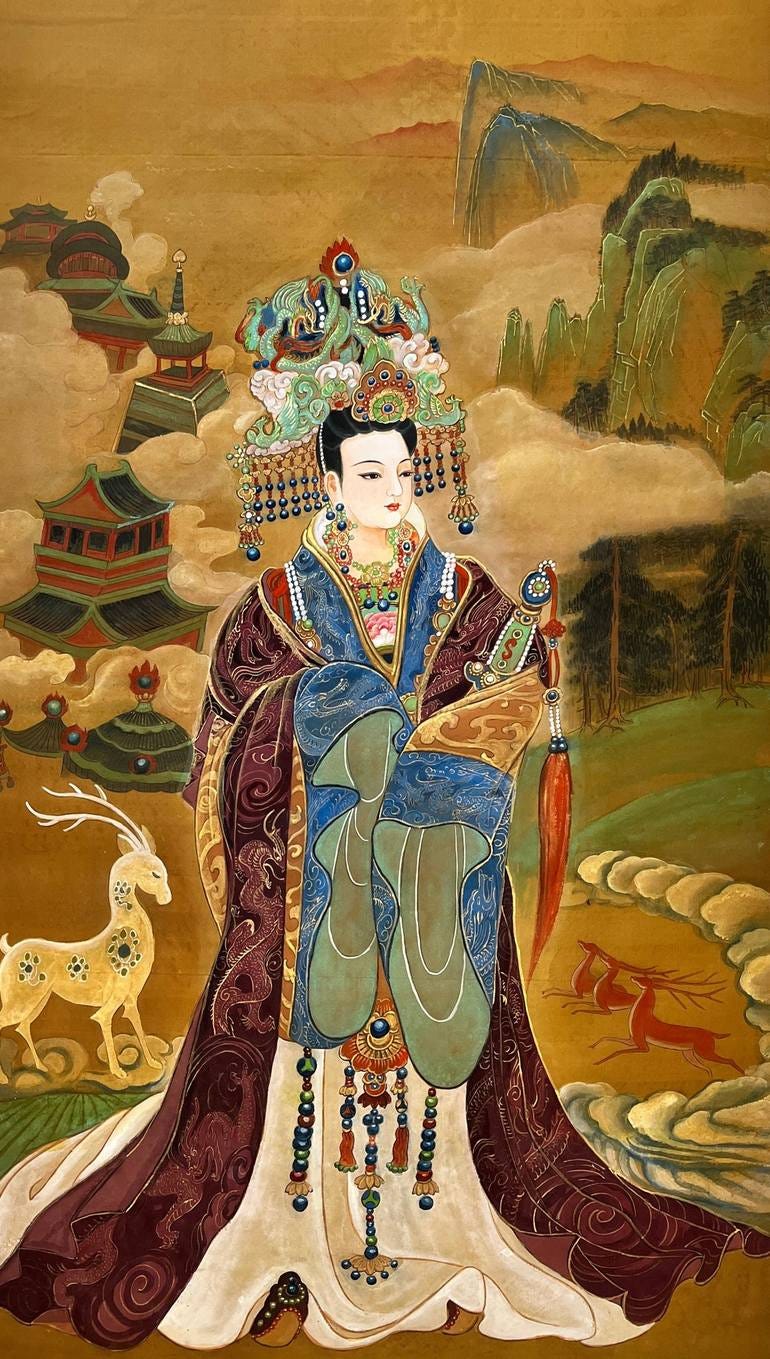
The Dragon Empress: Wu Zetian, China’s Sole Female Emperor
The Dragon Empress: Wu Zetian
China’s Empress Wu Zetian (武則天) is remembered in Chinese history as a controversial woman of questionable ethics and morals. The only female Empress to sit on the Dragon throne, in the archives of Chinese history; few figures are as transformative or as controversial. She soared from a barely noticed junior concubine in the Tang dynasty’s harem, to become the supreme sovereign of the Tang Dynasty, she shattered the ultimate Confucian taboo to rule as Huangdi, Emperor, in her own powerful right. Her reign 690–705 CE was a period of significant political, cultural, and religious transformation that continues to provoke fascination and debate.
While often depicted in later histories as a monstrous usurper, an image heavily influenced by the male scholars who wrote them. However, modern scholarship creates a more nuanced historical vision. Wu Zetian was not only a ruthless schemer; she was a masterful politician, a patron of Buddhism, and an administrative reformer whose legacy is inextricably tied to the zenith of Tang power and culture.[1]
This is the story of the woman who dared to claim the Mandate of Heaven for herself.
Wu Zetian’s path to power was unprecedented, and never again accomplished in China. She entered the palace of Emperor Taizhong approximately at age 14 as a low-ranking concubine, cairen.[2] After his death, in a bold and risky move that defied convention, she became a concubine of his son, the new Emperor Gaozong. Her intelligence and political acumen quickly made her indispensable. She outmaneuvered Empress Wang to take the position of Empress herself in 655, a move that involved a dramatic and much contested accusation against her rival.[3]
As Empress, Wu was far from a passive consort. Wu’s ascent was a decades long exercise in strategic brilliance. When Gaozong suffered debilitating illness, Wu stepped into the vacuum of power, first as co-regent and then as the power behind the throne. She became the de facto ruler, handling state affairs from “behind the curtain.” After his death in 683, she ruled as empress dowager through her sons before ultimately deposing them. In 690, she founded her own dynasty, the Zhou, and formally ascended the throne as Emperor Shengshen.[4]
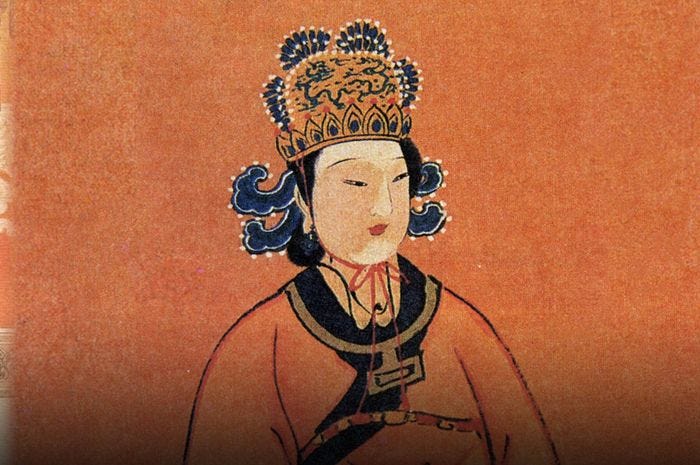
Female Brilliant Substantive Governance
Her political methods were pragmatic and often brutal, utilizing a network of informers to suppress aristocratic opposition.[5] This atmosphere of surveillance, while effective for control, contributed to her historical reputation for ruthlessness. However, to label her rule simply as “tyranny” overlooks her brilliance in substantive governance. She effectively weakened the old, militarized aristocracy by promoting the imperial examination system, recruiting officials based on merit and loyalty to the throne rather than noble birth. This move centralized authority and stabilized the bureaucracy, a policy that outlasted her dynasty.[6] Wu promoted women to governance, encouraged female education, and offered anyone with talent the ability to serve. She commissioned agricultural manuals, lowered taxes at times, and raised the status of farmers in official rituals, demonstrating a concern for economic stability and popular welfare.[7] She also expanded the empire’s military reach and implemented policies that strengthened central authority.
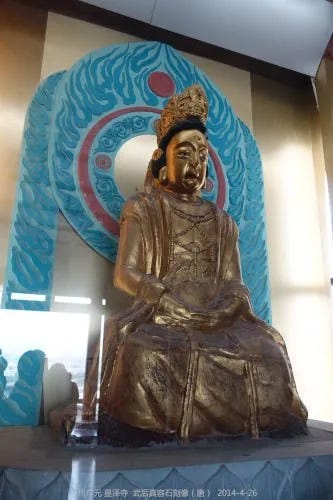
The Battle for Legitimacy: Propaganda, Religion, and Symbolism
Wu’s greatest challenge was not administrative but ideological. The Confucian framework that structured China explicitly prohibited women from holding sovereign power, famously stating that “a hen crowing in the morning heralds the downfall of a family.” [8] She brilliantly overcame this by orchestrating a multi-front campaign of legitimization. Wu utilized Buddhism as a powerful ideological tool. Her supporters commissioned commentaries on a Mahayana scripture, the Great Cloud Sutra, which prophesied that a female deity would be reborn as a ruler to govern a great kingdom. Wu Zetian was presented as the fulfillment of this divine prophecy.[9] She sponsored the construction of monumental Buddhist art, most famously the colossal statues at the Longmen Grottoes, visually linking her reign to divine favor and universal kingship. As Judith Boltz details, Wu Zetian strategically constructed a “pantheon of devis, divinities, and dynastic mothers.”[10] She elevated female deities and historical figures, reshaping religious and historical narratives to create a symbolic space for female authority within Chinese tradition. She even invented new Chinese characters, including her chosen name, Zhao (曌), which combined the symbols for “sun” and “moon” above “void;” a character meant to signify her illuminating rule overall.[11]
The Historical Dragon Matriarch: Assessment and Legacy
For centuries, Confucian historians have condemned Wu Zetian as a usurper, a murderous schemer, and a sexually immoral villainess. This traditional view, as Dien discusses, often framed her story as a cautionary tale about the dangers of female power in a patriarchal system.[12]
Modern scholars offer a more nuanced historical view. While not ignoring the political violence of her court, historians recognize her as an exceptionally shrewd politician and an effective ruler who presided over a prosperous and culturally vibrant period. She ensured a smooth continuation of the Tang’s “cosmopolitan” character, as described by Mark Edward Lewis.[13] Her patronage of Buddhism left an indelible mark on Chinese art and religion.
Wu Zetian’s ultimate legacy is a paradox. She proved that a woman could not only seize but also successfully wield the highest authority in a vast empire, demonstrating administrative expertise that sustained a golden age. Yet, her very success reinforced the traditional anxiety over female power. Wu Zetian’s legacy is her undeniable success. For fifteen years, she ruled one of the world’s greatest empires with authority and vision. She created a blueprint for female power in a system designed to exclude it, using every tool available; political, religious, and symbolic, to claim her place as the Dragon Emperor. She remains a towering, controversial, and utterly unique figure in world history.
I really appreciated this one, Dorie. I’m realizing how much of my understanding of China came through pretty narrow entry points, and your historical work keeps opening that up for me in such a grounded, human way. Wu Zetian’s story, especially the layers around power, legitimacy, and narrative, was fascinating. Thank you for sharing these glimpses. I'm grateful for them.
I have to research more about her. She seems fascinating. Thank you for these well balanced and well researched insights